Hey there, fellow play lovers! Today I want to cut through the noise around magnetic tiles—especially the big question I get all the time from parents, teachers, and daycare leads: Can these colorful little plastic squares actually work for group play? As someone who’s been in the magnetic tiles game for years, I’ve seen them work solo, sure, but let me tell you—they’re made for groups. No fancy marketing, no overhyped claims, just real play moments that’ll make you wonder why you didn’t pair them up sooner. Magnetic Tiles
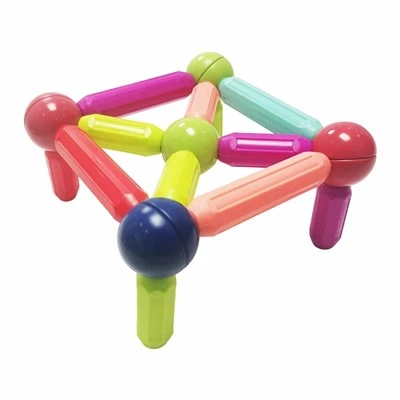
First off, let’s talk about the stuff that makes magnetic tiles tick. I know a lot of people see them as just building blocks with a magnet trick, but there’s actual science here—shoutout to the physics of ferromagnetism that lets them snap tight at every edge without falling apart mid-tower. But here’s the thing: that super strength isn’t just for single builders. When 3 or 4 kids huddle around a play mat, passing tiles, shouting “Wait, pass the blue triangle!” and adjusting a bridge together, that magnetic hold is a lifesaver. No more single-player meltdowns from wobbly towers—groups can build big without everything collapsing every 2 minutes. I’ve watched a group of 5-year-olds build a tiny castle that stayed up for 20 minutes straight, all because they were cooperating to line up the edges just right. That’s not luck—that’s how these tiles are engineered to work with more than two hands.
Now let’s get into the group play magic, because it’s not just about building big. It’s about how these tiles break down social barriers. I used to work at a daycare before jumping into supplying magnetic tiles, and I saw it firsthand: two kids who never spoke would get paired up to build a zoo, one grabbing a big square for the elephant pen, the other hunting for red tiles for the monkey bars. No pressure, no turn-taking fights over a single toy—there’s enough tiles in a standard set for 3 to 6 kids to have their own spots to contribute. I remember one set where a quiet kid who hated sharing toys started leading the group, because they noticed the curved tiles for the snake enclosure no one else was grabbing. That’s the thing about group play with magnetic tiles—everyone gets a role, even if you’re not the “loud builder” type.
Wait, let’s address the biggest pushback I get: “Won’t they just argue over tiles?” Yeah, if you give each kid a tiny set and tell them to build the same thing. But when you have a big enough stock (and trust me, I stock up on extras because I’ve seen the chaos of not enough blue triangles) and assign loose, collaborative goals? That’s when it works. Last month I sent a set to a elementary school’s after-school program, and the teacher told me the kids didn’t fight once—they split into two teams to build a mini city, one doing the road system, the other the park with a slide made of slanted tiles. The only disagreement was whether to add a ferris wheel with silver circular tiles. That’s healthy conflict, not toy hoarding. Magnetic tiles turn “my block” into “our structure” way faster than any other toy I’ve worked with.
Another angle: developmental stuff, right? Group play is huge for kids’ social skills, and magnetic tiles make that learning tangible. A lot of parents don’t realize that when kids work together to build, they’re practicing spatial reasoning, communication, and even basic engineering without realizing it. When they say “Pass the long rectangle to make the ramp steeper,” that’s them using language to solve a problem. When the tallest kid says “I can hold this tower steady while you add the roof,” that’s teamwork. I’ve had teachers tell me these tiles are a go-to for circle time activities where everyone has to add one piece to a big rainbow arch. No more sitting still—they’re engaged, talking, and building something together. That’s way better than coloring sheets for group time, let’s be real.
Now, let’s talk about how to actually make this work, because I don’t want you to just buy a set and get frustrated. First, size matters. A small 30-piece set is for 1 or 2 kids max. But a 100+ piece set? That’s for groups of 4 to 6. I always tell my buyers to skip the tiny sets if they’re shopping for classrooms, playdates, or daycare. Second, loose goals, not strict rules. Don’t say “Build a house.” Say “Build something that holds 3 toy animals.” That gives room for all the kids to contribute their own ideas—one might add a tower, another a garage, another a tiny pool. Third, mix shapes! I see a lot of people stick to squares, but triangles, circles, and half-circles open up so many group possibilities. A curved tile is perfect for a playground slide, a triangle makes a great roof support. More shapes = more roles for every kid.
Wait, what about older kids? I know a lot of people think magnetic tiles are just for toddlers, but I’ve seen middle schoolers use them for group science projects—building mini roller coasters that don’t fall apart, or even small models of cell structures? Yeah, no joke. A group of 7th graders used our tiles to build a working DNA model for a class presentation, and their teacher emailed me saying it was the best project in the whole grade. So it’s not just little kids—group play with magnetic tiles works for ages 3 to 13, at least. That’s a huge range, right?
Let me also talk about durability, because I’m a supplier, so I stand behind the product. These tiles are made from thick, BPA-free plastic—they don’t chip easily, and the magnets don’t lose their pull after thousands of snaps. When you have a group of kids grabbing, passing, and stacking them, that’s important. No broken tiles mid-build, no frustrated kids when their piece snaps in half. I supply to lots of schools and playgroups, and I’ve never had a bulk set returned for durability issues. That consistency makes group play way less stressful for both kids and the adults supervising.
I know some people are worried about cost, too. But think about it: a good quality magnetic tile set is an investment. Instead of buying separate toys for group play—like big blocks that are heavy and hard to store, or puzzles that only work with one person—you get a set that grows with the group. One set can be used for a playdate, a class activity, a birthday party game, even a rainy day at home with cousins. I’ve had a customer tell me she uses her set every weekend for neighborhood kids to come over and build together. That’s way more bang for your buck than any single-use group toy.
Let’s get real for a second. Group play can be a headache. There’s scheduling, different kid personalities, toys that break, arguments over who gets what. But magnetic tiles take a lot of that stress away because they’re flexible, engaging, and everyone can contribute. I’ve seen shy kids come out of their shell because they had a specific tile someone else needed. I’ve seen former strangers become friends because they built something cool together. I’ve watched teachers cut down on conflict time because the tiles give the kids a shared goal.
At the end of the day, magnetic tiles aren’t just solo play toys. They’re group play tools that help kids connect, create, and learn without even realizing it. The next time you’re planning a playdate, a classroom activity, or even a family gathering with multiple kids, skip the board games that get boring after 10 minutes. Grab magnetic tiles. I promise you’ll end up with kids laughing, cooperating, and building something awesome together.
If you’re in the market for magnetic tiles for group play—whether that’s a daycare, school, play center, or just a regular household with lots of kid visitors—feel free to reach out to talk more about bulk sets, different shapes, or how to set up the best group play time. We can work together to find the right stock that fits your space and needs.
Magnetic Sticks References:
- National Association for the Education of Young Children. (2020). Play and Learning: Connecting Development and Practice.
- American Academy of Pediatrics. (2018). The Power of Play: A Pediatric Role in Enhancing Development in Young Children.
- Liu, Y. et al. (2021). Ferromagnetic Materials in Educational Toys: Impact on Collaborative Play. Journal of Child Development and Play.
Xiamen Zhaobao Magnet Co., Ltd.
With abundant experience, we are one of the most professional magnetic tiles manufacturers and suppliers in China. Please feel free to wholesale advanced magnetic tiles made in China here from our factory. All customized products are with high quality and competitive price.
Address: Room 201, No.15, Longxinli, Siming District, Xiamen, Fujian, China
E-mail: zb16@magnets-world.com
WebSite: https://www.zbmagnet-king.com/
