If you’ve ever tried solo practice on a regular pool table and felt like something’s off—like you’re missing the precision of snooker’s tight pockets, the way the balls roll differently on that cloth, or the thrill of lining up a long red—you’re not alone. I’ve been in this spot, running a snooker pool table supply business for a minute, and I hear this question all the time: “What’s the best way to practice snooker alone on a pool table?” Let’s cut the fancy coach jargon here—no stuffy drills that don’t work, just real, doable stuff that actually improves your game, whether you’re rocking a full-size snooker table or making do with a pool table in your garage (hey, we’ve all been there when budget’s tight). Snooker Pool Table

First off, let’s get one thing straight: a pool table isn’t a snooker table, but that doesn’t mean you can’t work on core snooker skills on it. The main differences, for anyone who’s new, are pocket size (pool pockets are way wider, so you can get away with sloppy shots snooker would penalize you for) and cloth speed (pool cloth usually slides a little faster than standard snooker cloth, which is designed for controlled, precise rolls). But here’s the thing: the skills that matter most for snooker—aim, angle control, cue ball path, pace—translate straight over. You just have to adjust your drills to make up for those two big differences. No need to drop thousands on a full snooker table right away if you’re still figuring out your solo routine.
Let’s start with the most underrated solo snooker skill: aim. On a pool table, you can’t get away with guessing like you might when playing 8-ball with friends. The wide pockets hide a lot of mistakes, so practicing aim here actually trains your brain to lock in the exact contact point on the object ball—something that’ll make you way more consistent when you eventually get on a snooker table. The best drill here is called the “Linear Red Drill.” Grab 1-2 reds (or pool balls, same principle) and line them up in a straight line about 12 inches apart, from the middle of the pool table’s head spot to the side pocket. Your goal is to pot each one in that side pocket, one after another, without missing. Wait, but since pool pockets are wider, add a tiny challenge: close one eye halfway through (or just imagine the snooker pocket is half the size) and only pot it if you can trace a straight line from the cue ball’s contact point to the pocket’s far edge. This forces you to focus on fine-tuning your alignment, not just swiping at the ball. I swear by this one because I’ve seen guys go from missing easy long pots to nailing them 8 out of 10 times after a week of doing this 10 minutes a day. It’s not flashy, but it works.
Next up: cue ball control. This is where snooker separates the beginners from the guys who can pull off those amazing break builds you see on TV. And you can practice this perfectly on a pool table—you just have to set up positions that mimic snooker’s tight table layout. Snooker has 21 balls total, while a standard pool table has 15, so adjust for that. Here’s my go-to drill: the “3-Ball Position Play.” Grab three balls: one cue ball, one red, and one colored ball (use a solid or stripe, doesn’t matter). Place the red on the center of the pool table, the colored ball 18 inches away from the red, toward the top rail. Your goal is to pot the red into the corner pocket, and make the cue ball end up exactly where the colored ball was—no overshoot, no undershoot, dead on. The key here is to vary the pace and cue tip height: if you want the cue ball to stop dead after hitting the red, use a soft, center-hit. If you want it to roll forward to the colored ball’s spot, use a medium pace with a slight topspin. If you want it to draw back, hit low with a little more power. Do this 15 times in a row, mixing up where you send the cue ball—sometimes draw back to the bottom rail, sometimes follow to the middle, sometimes put a little side spin to nudge it just right. On a snooker table, this exact skill will let you leave yourself on a perfect position for your next red, instead of messing up the whole break because you misjudged the cue ball’s path. Pro tip: if you’re struggling, slow down. A lot of new players whack the cue ball too hard, and that’s where mistakes happen. Take half a second to line up your cue, take a smooth backswing, and hit through the ball. You’ll get way better results.
Now, let’s talk about long potting—something every snooker player works on, even the pros. On a pool table, long pots are a little easier because of the wider pockets, but that just means you can practice them more often without getting frustrated. The best drill here is the “Distance Progression Pot.” Start with a ball six inches from a corner pocket. Once you pot that, move it six inches further away. Keep doing this until you can consistently pot a ball from 3 feet away. Then, once you nail that, start mixing in slight angles—don’t just line it up straight, practice potting balls from 15, 30, 45-degree angles. Snooker long pots are all about judging that tiny contact point on the pocket edge, and this drill trains your eye to do that, even when the pockets are a little forgiving. I used to do this when I was practicing in my spare room before I started supplying tables, and it got my long pot percentage up from 50% to 80% in about a month. Worth every minute.
Wait, but what about when you’re on a pool table and you want to simulate the actual snooker table’s feel? A common mistake solo players make is treating the pool table like a second-class snooker table, but you can tweak it to get way closer. The cloth is the big one—most cheap pool tables have coarse cloth that makes balls roll faster. If you can, pick up a snooker-style cloth for your pool table (we sell these, by the way) that has a tighter weave, just like full-size snooker tables. That changes the roll so much—you’ll notice how balls slow down more predictably, just like they do on a regulation snooker table. Another tweak: pocket liners. Pool pockets are way wider, so add narrow pocket liners that match the size of snooker pockets. This makes every pot you practice feel way more like a real snooker shot, so when you eventually get on a real table, it’ll feel second nature. A lot of guys don’t know about these, and they waste a ton of time practicing on a table that doesn’t replicate what they’re actually trying to play.
Oh, and don’t sleep on the “solo frame drill” if you want to build up endurance and focus. Snooker is a long game—you can’t just rush through shots, you have to stay calm and focused for multiple rounds. The solo frame drill is perfect for that. Set up a small snooker setup on your pool table: 6 reds scattered around the center, colored balls on their spots (adjust for pool table size, obviously—just place them in similar positions). Play a full frame by yourself, keeping score, just like you would against another player. You have to focus on every shot, plan your next move, and not rush. This builds the mental stamina that’s just as important as physical skill in snooker. I can’t tell you how many players I’ve met that can pot 10 balls in a row in practice, but can’t finish a full frame because they get distracted or rush at the end. This drill fixes that.
Now, let’s get real about what doesn’t work. I see a lot of guys on TikTok doing fancy “snooker drills” on pool tables that basically boil down to swiping at balls as fast as possible. That’s not practice—that’s just wasting time. The best drills are consistent, small, and focused on one skill at a time, not trying to do everything at once. If you only have 10 minutes a day, don’t do 10 different drills. Do one drill really well—like the linear red aim drill—and you’ll see way more progress than bouncing around from drill to drill. Consistency beats intensity every time here.
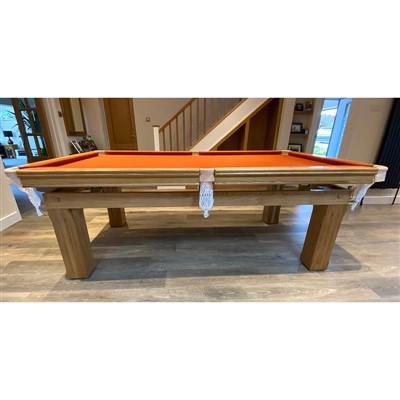
If you’re serious about taking your practice up a notch, investing in a proper snooker pool table (yes, that’s what we supply) is a game-changer. We’ve got tables that blend the best of both worlds—regulation snooker dimensions with adjustability, so you can switch between snooker and 8-ball in seconds. The cloth is the exact same as pro-level snooker tables, the pockets are regulation size, and the slate is the same thickness that pros use for consistent ball roll. A lot of people ask me, “Can I just use a pool table forever?” And yeah, you can—you’ll get better, but you’ll hit a ceiling that’s hard to break because the table doesn’t match the actual game you want to play. For guys who practice solo regularly, a proper table makes a huge difference because you’re practicing the exact same conditions every time.
At the end of the day, the best way to practice snooker alone on a pool table is to focus on the core skills that matter, tweak your setup to mimic snooker as much as possible, and stay consistent with small, focused drills. No need for fancy equipment or hours of time—15-20 minutes a day, done right, is way more effective than an hour of messy, unplanned shots.
If you’re ready to level up your practice (or upgrade your table to match), reach out to us to talk through what works for you—whether you’re a casual player looking to practice in your garage or a serious player prepping for a tournament. We’re here to help you get the most out of your solo practice, so you can play your best whenever you step on the table.
Billiards References
- World Snooker Coach Association. (2022). Core Skill Development for Solo Snooker Practice. Snooker Training Journal.
- Billiard Congress of America. (2021). Table Adjustments for Cross-Discipline Practice: Snooker on Pool Tables. BCA Technical Bulletin.
- Pro Snooker Players Association. (2023). Endurance and Focus Drills for Solo Competitive Play. PSAA Training Manual.
Shuai Zhanjiang (Dongguan) Co., Ltd.
As one of the leading snooker pool table manufacturers and suppliers in China, we offer a wide range of products with superior quality. Please rest assured to buy snooker pool table made in China here from our factory. We also accept customized orders.
Address: No. 50 Siyuan Road, Changping Town, Dongguan City, Guangdong Province
E-mail: cbibilliard01@gmail.com
WebSite: https://www.cbibilliard.com/
